
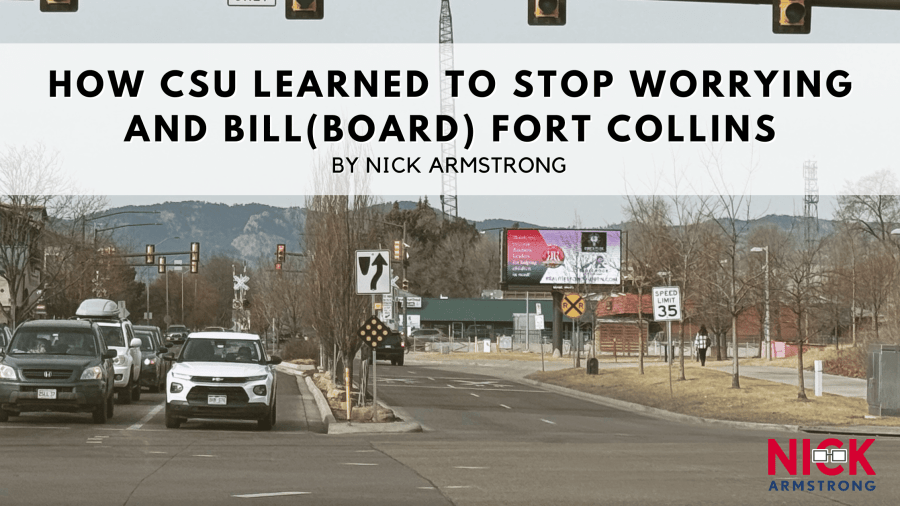
Colorado State University has, against Fort Collins city code and the will of the citizens of Fort Collins, decided to install what it claims are “safety”-focused billboards along major transit corridors around campus.
In actuality, these massive 11×22′ electric billboards were provided to the University for free by Street Media Group and are aimed squarely at backfilling the University’s $48 million budget shortfall (CSU’s CFO connected the billboards to a specific budget shortfall in sworn testimony before a legislative committee).
Update: In an earlier version of this blog, I incorrectly indicated that the billboards net the University $48 million in annual advertising revenue, and this was a misread on my part of the Coloradoan article. The actual income from the advertising revenue is unknown but likely to be somewhere between $5K-10K/mo per billboard based on industry averages, which would put the annual ad revenue around $300-400K/year.
Because they are a land-grant institution, CSU can only be reined in at the State level, and a recently introduced bill to do so failed much to the consternation of CSU students, neighbors, and officials from the City of Fort Collins.
There was simply no need for this University-level grift. Historical perspective shows us why, via The Gardens on Spring Creek and the UCA + Experimental Flower Gardens. From the Gardens on Spring Creek’s Website: “funding for the creation of a community horticulture center was placed on the ballot as part of Building Community Choices (BCC). In 1997, Fort Collins voters enthusiastically supported BCC with 71% voting in favor of the proposal. $2 million was appropriated to create what is now The Gardens on Spring Creek.
Once initial funding was secured, the next step was to identify a location. Several sites across Fort Collins were considered. This site, in the Spring Creek corridor, was selected for its centrally located 18 acres. The Colorado State University Research Foundation (CSURF), a not-for-profit organization, owned the land originally. In a land-swap deal, the City of Fort Collins traded what is now the Annual Flower Trial Gardens at College and Lake Street for our site. The City also paid an additional sum for the land.“
When the town and gown relationship works like it should, CSU and Fort Collins not only peacefully co-exist, but co-create solutions that provide generational benefit. This is the same institution that tracked pandemic spread via wastewater and developed new protective equipment to keep scientists safe in the process.
Which makes it all the more disappointing that CSU has a pattern of choosing extraction over partnership when financial pressure mounts.
These billboards aren’t the first time that Colorado State has failed to live up to the much ballyhooed “town and gown” relationship.
Back before Hughes was a municipal ordinance protected space, it was owned by CSU and was the home of CSU Rams Football for decades, some truly awesome rock concerts including Elton John and The Rolling Stones, and even a Bob Dylan live album. CSU decided to move the stadium on campus with 60% of the voting public of Fort Collins in opposition.
No problem, I imagine CSU leaders thinking, we’ll do a fundraiser and the real fans will come out.
The San Diego Union Tribune catalogued what happened next: “After a public fund-raising effort that brought in $50 million in donations, but fell short by half of the goal, CSU decided to bank the donations and sell 30-year revenue bonds worth $239 million.
From 2020 through 2050, the debt service on those bonds will be $12.2 million per year.“
In the shadow of this massive debt service, CSU looked for options, and where it had been investing in restoring and recuperating the Hughes stadium land, the spark of what can only be generously described as a grift began to form.
In 2016, when CSU vacated the site, the City of Fort Collins Natural Areas Department declined to purchase it, citing a $12 million price tag and millions in additional remediation costs beyond the $3M already invested by CSU because they would significantly limit the department’s ability to conserve “truly pristine” land in the future. Natural Areas staff also emphasized that their “purchasing power for other properties” would be directly affected by how many acres of Hughes they were expected to manage as a natural area.
City planners and CSU staff have repeatedly noted that the site is heavily disturbed, having been used for decades as a gravel pit, staging area, and stadium site — meaning it lacks the ecological characteristics typically prioritized for natural area designation and would require extensive (and expensive) rehabilitation.
It was a no-go from City officials because they knew the value of the Hughes land was being overplayed and the rehabilitation costs were wildly downplayed.
To gain a negotiation advantage and push the urgency for conservation-minded citizens into emergency mode, CSU framed the Hughes property value around development *potential* and infrastructure readiness that did NOT exist, while downplaying the actual remediation costs needed to make the site workable for any large-scale project and anchored the cost of the property to this absolute fiction.
CSU turned down the City’s fair $7.2 million offer, then later agreed to a “fair market value” $12.5 million sale after voters passed the ballot measure to prevent CSU from selling it to anyone else, especially an all-too-willing-to-play-along developer.
My feel is CSU created the conditions for an overly-inflated land value without accounting for what it actually would have cost to make the site ready for development.
When the specter of the sale of the Hughes land sparked a conservation ballot measure from a concerned Fort Collins citizenry, I wrote extensively about the method CSU used to artificially inflate the value into the stratosphere and how the PATHS folks were playing right into their hand, and as a result EVERY taxpayer in Fort Collins now foots that bill.
The greed CSU is displaying now with these billboards is shameful – same song, different verse. Sweating its own financial decisions and a federal government treating university funding as a political weapon, CSU has decided Fort Collins residents are again the ones who should foot the bill.
I wish I could look at my Alma Mater and say, “In the face of extreme fear, the true values of truth, integrity, courage, and conviction shone through.” Instead, all I see is a bright and shining billboard-powered cash grab.
What has changed so fundamentally that when the chips are down, CSU cannot be relied upon?
 Nick Armstrong